
Closing
 WARNING
Monitor the closing procedure carefully to make sure no one is in danger of being injured. To prevent possible personal injury, always keep hands and fingers away from the cargo compartment opening when closing the tailgate. Be especially careful when small children are around. To stop the closing procedure, do one of the following:
- Press or pull the remote tailgate opening/ closing switch on the driver's door.
- Press the tailgate closing switch.
- Press the KEYLESS-GO locking/closing switch.
- Pull outside handle on the tailgate.
- When no SmartKey is inserted in the starter switch (vehicles with KEYLESS-GO:
Make sure the vehicle's on-board electronics have status 0): Press button
 on the SmartKey.
You can close the tailgate automatically using the SmartKey, the closing button or the locking button.
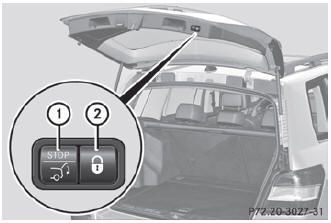
Closing button and locking button (example: vehicle with the EASY-PACK tailgate and KEYLESSGO)
- To close: press closing button 1 on the tailgate.
or
- Press and hold the button
on the SmartKey until the tailgate closes.
- To close and lock simultaneously: Press locking button 2 on the tailgate.
 The tailgate can only be opened and closed with the SmartKey if there is no
SmartKey in the ignition lock.
The tailgate can only be opened and closed with the SmartKey if there is no
SmartKey in the ignition lock.
If the tailgate touches an object while closing, the closing procedure is interrupted and the tailgate reopens.
If you leave a KEYLESS-GO key in the cargo compartment, the tailgate will not
lock.
The tailgate is not closed unless a KEYLESS-GO key is detected.
See also:
Drinking and driving
WARNING
Drinking and driving and/or taking drugs and
driving are very dangerous combinations.
Even a small amount of alcohol or drugs can
affect your reflexes, perceptions and
judgment.
The ...
Cleaning the exterior lighting
Clean the plastic lenses of the exterior
lights with a wet sponge and a mild cleaning
agent, e.g. Mercedes-Benz car shampoo or
cleaning cloths.
Only use cleaning agents or
cleaning
...
AMG displays
•► Press on the steering wheel
to select the AMG menu.
1. Digital speedometer
2. Gear indicator
3. Upshift indicator
4. Engine oil temperature
5. Coolant temperature
Upshi ...