
Checking the coolant level
Only check the coolant level when the vehicle is on a level surface and the engine has cooled down.
Turn the SmartKey to position 2 in the ignition lock.
On vehicles with KEYLESS-GO, press the Start/Stop button twice (Y page 145).
•► Check the coolant temperature display in the instrument cluster.
The coolant temperature must be below 158 °F (70 °C).
 WARNING
In order to avoid any potentially serious burns:
- use extreme caution when opening the hood if there are any signs of steam or coolant leaking from the cooling system, or if the coolant temperature display indicates that the coolant is overheated.
- do not remove the pressure cap on the coolant reservoir if the coolant temperature is above 158 °F (70 °C). Allow the engine to cool down before removing the cap. The coolant reservoir contains hot fluid and is under pressure.
- using a rag, slowly turn the cap approximately 1/2 turn to relieve excess pressure. If opened immediately, scalding hot fluid and steam will be blown out under pressure.
- do not spill antifreeze on hot engine parts.
Antifreeze contains ethylene glycol which may burn if it comes into contact with hot engine parts.
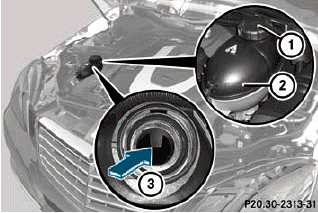
•► Slowly turn cap 1 half a turn counterclockwise and allow excess pressure to escape.
•► Turn cap 1 further counter-clockwise and remove it.
If the coolant is at the level of marker bar 3 in the filler neck when cold, there is enough coolant in coolant expansion tank 2.
If the coolant is approximately 0.6 in (1.5 cm) above marker bar 3 in the filler neck when warm, there is enough coolant in coolant expansion tank 2.
•► If necessary, add coolant that has been tested and approved by Mercedes-Benz.
•► Replace cap 1 and turn it clockwise as far as it will go.
For further information on coolant.
See also:
Downhill gradients
On long and steep gradients, you must
reduce the load on the brakes by shifting
early to a lower gear. This allows you to take
advantage of the engine braking effect and
helps avoid overheati ...
Setting the front-compartment airflow
using the front control panel
You can select different airflow settings for
the driver's and front-passenger sides as well
as for the rear compartment.
You can also use COMAND to set the airflow.
Turn the SmartKey to positi ...
Important safety notes
It is particularly important to use a safety net
if the vehicle is loaded with small objects
above the level of the backrests. For safety
reasons, always use a cargo net when
transporting load ...