
Tire tread
WARNING
Although the applicable federal motor vehicle
safety laws consider a tire to be worn when
the tread wear indicators (TWI) become
visible at approximately 1/16 in (1.6 mm), we
recommend that you do not allow your tires
to wear down to that level. As tread depth
approaches 1/8 in (3 mm), the adhesion
properties on a wet road are sharply reduced.
Depending upon the weather and/or road
surface (conditions), the tire traction varies
widely.
Do not use tires that are excessively worn as the tire traction on wet road surfaces decreases significantly when the tread depth is less than 1/8 inch (3 mm).
Tread wear indicators (TWI) are required by law. Six indicators are positioned on the tire tread. They become visible as soon as a tread depth of approximately 1/16 inch (1.6 mm) has been reached. If this is the case, the tire is so worn that it must be replaced.
The recommended tread depth for summer tires is at least 1/8 inch (3 mm). The recommended tread depth for winter tires is at least 1/6 inch (4 mm).
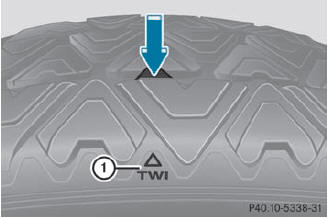
Bar marking 1 for tread wear is integrated into the tire tread.
See also:
Entering a point of interest in the
vicinity of the destination
Entering a point of interest in the vicinity of
the destination is only possible when route
guidance is active.
Select Destination Area from the menu
and press to confirm.
Continue with ass ...
Digital speedometer
Press the or
button on the
steering wheel to select the Trip menu.
Press or
to select the digital
speedometer.
1 Digital speedometer ...
Automatic headlamp mode
To switch on automatic
headlamp
mode: turn the light switch to
or .
SmartKey in position 1 in the ignition lock:
the parking lamps are switched on or off
automatically depending on the bri ...