
Rear seat head restraints
 WARNING
For safety reasons, always drive with the rear
head restraints in the upright position when
the rear seats are occupied.
Keep the area around head restraints clear of
articles (e.g. clothing) to not obstruct the
folding operation of the head restraints.
WARNING
For your protection, drive only with properly
positioned head restraints.
Adjust the head restraint in such a way that it
is as close to the head as possible and the
center of the head restraint supports the back
of the head at eye level. This will reduce the
potential for injury to the head and neck in the
event of an accident or similar situation.
With a rear seat occupied, make sure to move
the respective head restraint up from the
lowest non-use position and have the
occupant adjust the head restraint properly.
Do not drive the vehicle without the seat head
restraints installed when the rear seats are
occupied. Head restraints are intended to
help reduce injuries during an accident.
Adjusting the rear seat head restraint height
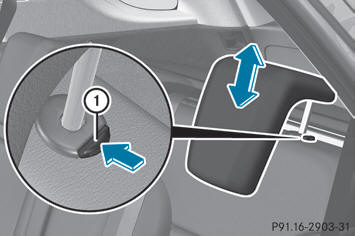
- If the head restraint is fully lowered, it is
necessary to press release catch 1.
- To raise: pull the head restraint up to the
desired position.
- To lower: press release catch 1 and push
the head restraint down until it is in the
desired position.
Adjusting the rear seat head restraint angle
Adjust the head restraints so that they are as close as possible to your head.
You can only adjust the two outer head restraints.
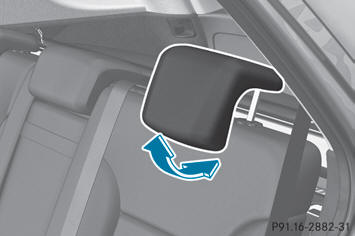
- Using both hands, reach backwards and
grasp the sides of the head restraint.
- Pull the lower edge of the head restraint
forwards or backwards until it is in the
desired position.
Removing and installing the rear seat head restraints
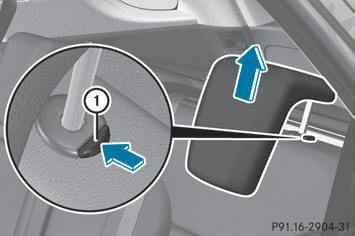
- To remove: pull the head restraint up to
the stop.
- Press release catch 1 and pull the head
restraint out of the guides.
- To re-install: insert the head restraint so
that the notches on the bar are on the left
when viewed in the direction of travel.
- Push the head restraint down until you hear
it engage in position.
See also:
Important safety notes
A license agreement must exist in order
to activate the mbrace service. Ensure that
your system is activated and ready for use,
and press the
MB Info call button to
register. If any o ...
Service messages
Information on the type of service and service
intervals (see separate Service Booklet).
You can obtain further information from an
authorized Mercedes-Benz Center or at
http://www.mbusa.com (U ...
Selector lever
Overview of transmission positions
Selector lever in AMG vehicles with P button
P Park position with parking lock
R Reverse gear
N Neutral
D Drive
Transmission position and drive
...