
Fastening seat belts
 WARNING
According to accident statistics, children are
safer when properly restrained on the rear
seats than on the front-passenger seat. Thus,
we strongly recommend that children be
placed in the rear seat whenever possible.
Regardless of seating position, children 12 years old and under must be seated and properly secured in an appropriately sized child restraint system or booster seat recommended for the size and weight of the child. For additional information, see the "Children in the vehicle" section.
A child's risk of serious or fatal injuries is significantly increased if the child restraints are not properly secured in the vehicle and/ or the child is not properly secured in the child restraint.
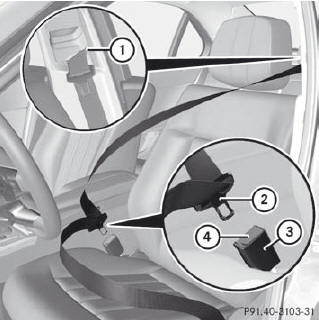
Example: Sedan
- Adjust the seat and move the backrest to an almost vertical position.
- Pull the seat belt smoothly through belt
sash guide 1.
- Without twisting it, guide the shoulder
section of the seat belt across the middle
of your shoulder and the lap section across
your hips.
- Engage belt tongue 2 in buckle 3.
Seat-belt adjustment: if necessary, the driver's and front-passenger seat belts automatically adjust to the upper body
- If necessary, adjust the seat belt to the
appropriate height.
- If necessary, pull upwards on the shoulder
section of the seat belt to tighten the belt
across your body.
All seat belts except the driver's seat belt are equipped with a special seat belt retractor to securely fasten child restraint systems in the vehicle. For further information on special seat belt retractors, see.
For more information about releasing the seat belt with release button 4, see "Releasing seat belts".
See also:
Engaging park position P
•► Push the DIRECT SELECT lever in the
direction of arrow P.
The automatic transmission shifts
automatically into park position P if you
open the driver's door when the vehicle is
stati ...
Canceling Parking Guidance
•► Press the PARKTRONIC button on the
center console (Y page 194).
Parking Guidance is canceled immediately
and PARKTRONIC is deactivated.
Parking Guidance is canceled automatically if
i ...
Lane Keeping Assist
Important safety notes
Lane Keeping Assist monitors the area in
front of your vehicle by means of a camera at
the top of the windshield. Lane Keeping Assist
detects lane markings on the road an ...