
Instruction labels for tires and loads
WARNING
Do not overload the tires by exceeding the
specified load limit as indicated on the Tire
and Loading Information placard on the
driver's door B-pillar. Overloading the tires
can overheat them, possibly causing a
blowout. Overloading the tires can also result
in handling or steering problems, or brake
failure.
Two instruction labels on your vehicle show the maximum possible load.
(1) The Tire and Loading Information placard on the B-pillar on the driver's side. The Tire and Loading Information placard shows the maximum permissible number of occupants and the maximum permissible vehicle load. It also contains details of the tire sizes and corresponding pressures for tires mounted at the factory.
(2) The vehicle identification plate is on the B-pillar on the driver's side. The vehicle identification plate informs you of the gross vehicle weight rating. It is made up of the vehicle weight, all vehicle occupants, the fuel and the cargo. You can also find information about the maximum gross axle weight rating on the front and rear axle.
The maximum gross axle weight rating is the maximum weight that can be carried by one axle (front or rear axle). Never exceed the maximum load or the maximum gross axle weight rating for the front or rear axle.
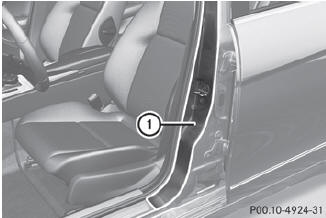
1 B-pillar, driver's side
See also:
Everything considered: integral Mercedes-Benz safety concept
The comprehensive Mercedes approach to integral safety also applies in the
new R-Class. This trailblazing safety philosophy goes well beyond compliance
with standardised crash test regulations. It ...
Diesel Delight
Despite its hefty, 5,040-pound curb weight, the ML350 Bluetec moves out well,
with power in reserve at midrange speeds. The diesel's power characteristics are
well-suited to towing, and the SUV is ...
Problems with the side windows
Problem: a side window cannot be closed
because it is blocked by objects, e.g. leaves in the window guide.
Remove the objects.
Close the side window.
Problem: a side window cannot be closed
...