
Maximum tire pressure
WARNING
Never exceed the maximum tire inflation
pressure. Follow recommended tire inflation
pressures.
Do not underinflate tires. Underinflated tires
wear excessively and/or unevenly, adversely
affect handling and fuel economy, and are
more likely to fail from being overheated.
Do not overinflate tires. Overinflated tires can
adversely affect handling and ride comfort,
wear unevenly, increase stopping distance,
and result in sudden deflation (blowout)
because they are more likely to become
punctured or damaged by road debris,
potholes etc.
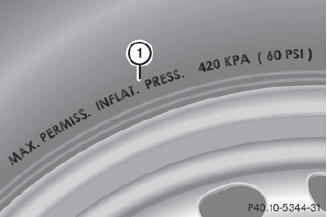
1 Maximum permitted tire pressure (example)
 The actual values for tires are
specific to
each vehicle and may deviate from the
values in the illustration.
The actual values for tires are
specific to
each vehicle and may deviate from the
values in the illustration.
When adjusting the tire pressures always observe the recommended tire pressure for your vehicle.
See also:
Maximum load rating
WARNING
Do not overload the tires by exceeding the
specified load limit as indicated on the Tire
and Loading Information placard on the
driver's door B-pillar. Overloading the tires
can over ...
Displaying navigation instructions
In the Navi menu, the multifunction display
shows navigation instructions. For more
information, see the separate operating
instructions.
Switch on COMAND (see the
separate
operating instr ...
4MATIC (permanent four-wheel drive)
4MATIC ensures that all four wheels are
permanently driven. Together with ESP® and
4ETS, it improves the traction of your vehicle
whenever a drive wheel spins due to
insufficient grip.
WARNING&nb ...