
Tires
WARNING
Do not drive with a flat tire. A flat tire affects the ability to steer or brake
the vehicle. You may
lose control of the vehicle. Continued driving with a flat tire will cause
excessive heat build-up
and possibly a fire.
WARNING
Follow recommended tire inflation pressures.
Do not underinflate tires. Underinflated tires wear excessively and/or unevenly,
adversely affect
handling and fuel economy, and are more likely to fail from being overheated.
Do not overinflate tires. Overinflated tires can adversely affect handling and
ride comfort, wear
unevenly, increase stopping distance, and result in sudden deflation (blowout)
because they are
more likely to become punctured or damaged by road debris, potholes etc.
| Display messages | Possible causes/consequences and
 Solutions Solutions |
 |
 Risk of accident Risk of accident
The tire pressure loss warning system has detected a significant
loss in pressure. |
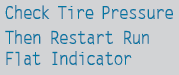 |
The tire pressure loss warning system generated a display
message and has not been restarted since. Set the correct tire
pressure in all four tires. Restart the tire pressure
loss warning system |
 |
The tire pressure loss warning system is defective. Visit a qualified
specialist workshop. |
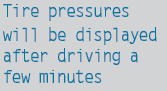 |
The tire pressure monitor is measuring the tire pressure. Drive on. The tire pressures appear in the multifunction display after you have been driving for a few minutes. |
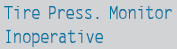 |
The tire pressure monitor is defective. Visit a qualified
specialist workshop. |
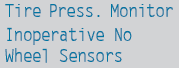 |
The wheels mounted do not have a suitable tire pressure sensor. The tire pressure monitor is deactivated. Mount wheels with suitable
tire pressure sensors.The tire pressure monitor is activated automatically after driving for a few minutes. |
 |
Risk of accident
The tire pressure in one or more tires has dropped significantly. |
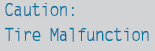 |
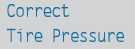
Risk of accident
The tire pressure in one or more tires has dropped suddenly. The
wheel position is displayed in the multifunction display. |
 |
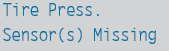
The tire pressure is too low in at least one of the tires or the
tire
pressure difference between the wheels is too great. Check the tire pressures at
the next opportunity. If necessary,
correct the tire pressure. Restart the tire pressure
monitor. |
 |
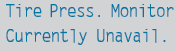
There is no signal from the tire pressure sensor of one or several
wheels. The pressure of the affected tire is not displayed in the
multifunction display. Have the defective tire
pressure sensor replaced at a qualified
specialist workshop. |
 |
Due to a source of radio interference, no signals can be received
from the wheel sensors. The tire pressure monitor is temporarily
malfunctioning. Drive on. The tire pressure monitor restarts automatically as soon as the problem has been solved. |
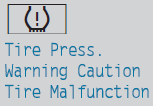 |
Risk of accident
The tire pressure in one or more tires has dropped suddenly. |
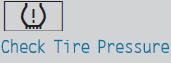 |
Risk of accident
The tire pressure in one or more tires has dropped significantly. |
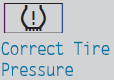 |
The tire pressure is too low in at least one of the tires or the
tire
pressure difference between the wheels is too great. Check the tire pressures at
the next opportunity. If necessary,
correct the tire pressure |
See also:
Parcel nets
WARNING
Vehicles with Occupant Classification System
(OCS)
Do not place objects with a combined weight
of more than 4.4 lbs (2 kg) into the parcel net
on the back of the front passeng ...
Vehicle identification number (VIN)
The vehicle identification number (VIN) can
be found in the following locations:
• on the vehicle identification plate
• at the lower edge of the windshield
In addition to being stamped on th ...
Speedometer with segments
The segments in the speedometer indicate which speed range is available.
Cruise control () activated: The segments light up from the stored
speed to the maximum speed. ...