
Tire size designation, load-bearing capacity and speed rating
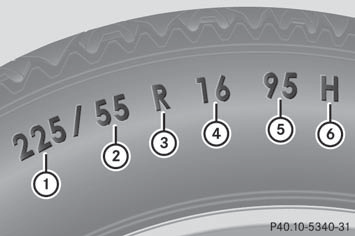
1 Tire width
2 Nominal aspect ratio in %
3 Tire code
4 Rim diameter
5 Load bearing index
6 Speed rating
 Tire data is vehicle-specific and may
deviate from the data in the example.
Tire data is vehicle-specific and may
deviate from the data in the example.
General: depending on the manufacturer's standards, the size imprinted in the tire wall may not contain any letters or may contain one letter that precedes the size description.
If there is no letter preceding the size description (as shown above): these are passenger vehicle tires according to European manufacturing standards.
If "P" precedes the size description: these are passenger vehicle tires according to U.S.
manufacturing standards.
If "LT" precedes the size description: these are light truck tires according to U.S.
manufacturing standards.
If "T" precedes the size description: these are compact emergency spare wheels at high tire pressure, to be used only temporarily in an emergency.
Tire width: tire width 1 shows the nominal tire width in millimeters.
Nominal aspect ratio: aspect ratio 2 is the size ratio between the tire height and the tire width and is shown in percent. The aspect ratio is calculated by dividing the tire width by the tire height.
Tire code: tire code 3 specifies the tire type.
"R" represents radial tires. "D" represents diagonal tires, "B" represents diagonal radial tires.
Optionally, tires with a maximum speed of over 149 mph(240 km/h) may have "ZR" in the size description depending on the manufacturer (e.g. 245/40 ZR 18).
Rim diameter: rim diameter 4 is the diameter of the bead seat, not the diameter of the rim flange. The rim diameter is specified in inches (in).
Load bearing index: load bearing index 5 is a numerical code which specifies the maximum load-bearing capacity of a tire.
 WARNING
The tire load rating must always be at least
half of the GAWR of your vehicle. Otherwise,
sudden tire failure may be the result which
could cause an accident and/or serious injury
to you or others.
Always replace rims and tires with rims and
tires having the same specifications
(designation, manufacturer and type) as
shown on the original part.
WARNING
Do not overload the tires by exceeding the
specified load limit as indicated on the Tire
and Loading Information placard on the
driver's door B-pillar. Overloading the tires
can overheat them, possibly causing a
blowout. Overloading the tires can also result
in handling or steering problems, or brake
failure.
Example:
The load bearing index 91 is equivalent to a
maximum load of 1356 lbs (615 kg) that the
tire can carry. For further information on the
maximum tire load in kilograms and pounds.
For further information on the load bearing index, see Load index.
Speed rating: speed rating 6 specifies the approved maximum speed of the tire.
WARNING
Even when permitted by law, never operate a
vehicle at speeds greater than the maximum
speed rating of the tires.
Exceeding the maximum speed for which tires
are rated can lead to sudden tire failure,
causing loss of vehicle control and possibly
resulting in an accident and/or serious
personal injury and possible death, for you
and for others.
Regardless of the speed rating always observe the speed limits. Drive carefully and adapt your driving style to the traffic conditions.
See also:
Switching on satellite radio mode
Notes
Important notes on registration, see
"Registering satellite radio".
Switching on satellite radio mode
Select Audio in the main function bar by
sliding and turning
the COMAND ...
Downloading destinations
Information on the components and
operating principles of COMAND can be
found in the separate COMAND operating
instructions.
You can only use the Destination
Download function if th ...
Switching on/off
The three blue indicator lamps in the buttons
indicate the ventilation level you have
selected.
If the battery voltage is too low, the seat
ventilation may switch off.
Make sure that the S ...