
Tire tread
 WARNING
Although the applicable federal motor vehicle
safety laws consider a tire to be worn when
the tread wear indicators (TWI) become
visible at approximately 1/16 in (1.6 mm), we
recommend that you do not allow your tires
to wear down to that level. As tread depth
approaches 1/8 in (3 mm), the adhesion
properties on a wet road are sharply reduced.
Depending upon the weather and/or road
surface (conditions), the tire traction varies
widely.
Do not use tires that are excessively worn as the tire traction on wet road surfaces decreases significantly when the tread depth is less than 1/8 inch (3 mm).
Tread wear indicators (TWI) are required by law. Six indicators are positioned on the tire tread. They become visible as soon as a tread depth of approximately 1/16 inch (1.6 mm) has been reached. If this is the case, the tire is so worn that it must be replaced.
The recommended tread depth for summer tires is at least 1/8 inch (3 mm). The recommended tread depth for winter tires is at least 1/6 inch (4 mm).
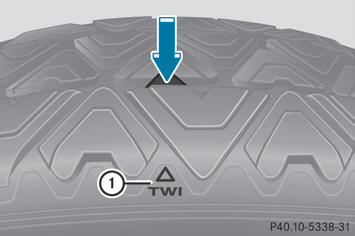
Bar marking 1 for tread wear is integrated into the tire tread.
See also:
"Coupling up a trailer" function
This function is only available on vehicles with
a trailer tow hitch.
1 Center of the vehicle on the red guide line
approximately 10 in (0.25 m) away from
the rear area
2 Center of the vehic ...
Fuse box in the engine compartment
Make sure that the windshield wipers are turned off.
WARNING
Make sure that the windshield wipers are switched off and that
the SmartKey is removed from the ignition lock before you open ...
Tread wear
The tread wear grade is a comparative rating
based on the wear rate of the tire when tested
under controlled conditions on a specified
U.S. government course. For example, a tire
graded 150 wo ...