
Deactivating/activating ESP®
 Observe the "Important safety
notes"
section.
Observe the "Important safety
notes"
section.
 WARNING
ESP® should not be deactivated during
normal driving other than in the
circumstances described below. Disabling
the system will reduce vehicle stability in
driving maneuvers.
Do not deactivate ESP® when the emergency
or spare wheel is mounted.
ESP® is activated automatically when the engine is started.
It may be best to deactivate ESP® in the
following situations:
- when using snow chains
- in deep snow
- on sand or gravel
WARNING
Switch on ESP® immediately if one of the
previously stated conditions is no longer met.
Otherwise, ESP® cannot stabilize the vehicle
if it begins to lurch or when a wheel spins.
When you deactivate ESP®:
- ESP® no longer improves driving stability.
- the engine's torque is no longer limited and
the drive wheels can spin. The spinning of
the wheels results in a cutting action, which
provides better grip.
- traction control is still activated.
- ESP® still provides support when you
brake.
If ESP® is deactivated and one or more wheels
start to spin, the  ESP® warning
lamp in
the instrument cluster flashes. In such
situations, ESP® will not stabilize the vehicle.
ESP® warning
lamp in
the instrument cluster flashes. In such
situations, ESP® will not stabilize the vehicle.
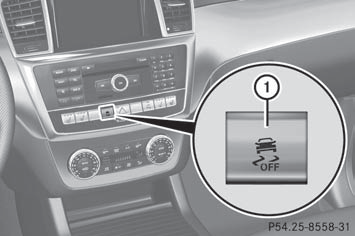
- To deactivate: press button 1.
The  ESP® OFF warning lamp in the
instrument cluster lights up.
ESP® OFF warning lamp in the
instrument cluster lights up.
WARNING
When the ESP® OFF warning
lamp is lit,
ESP® is deactivated.
If the ESP® warning lamp and
the
ESP® OFF warning lamp remain
lit,
ESP® is not available due to a malfunction.
When ESP® is deactivated or not operational,
vehicle stability in standard driving
maneuvers is reduced.
Adapt your speed and driving to the prevailing
road conditions and to the non-operating
status of the ESP®.
 Avoid spinning the driven
wheels for an
extended period with ESP® deactivated.
Avoid spinning the driven
wheels for an
extended period with ESP® deactivated.
You could otherwise damage the drivetrain.
- To activate: press button 1.
The ESP® OFF warning lamp in the
instrument cluster goes out.
See also:
Active Blind Spot Assist
Important safety notes
Active Blind Spot Assist uses a radar sensor
system to monitor the side areas of your
vehicle which are in back of the driver. A
warning display in the exterior mirrors d ...
Rejecting or ending a call
Press the button on the steering
wheel.
If you are not in the Tel menu, you can still reject or end a call. ...
Cruise control lever
1 To switch on or to increase the speed
2 To switch on or to reduce the speed
3 To deactivate cruise control
4 To switch on with the current speed or
with the last stored speed
When you ...