
Adjusting the headlamps
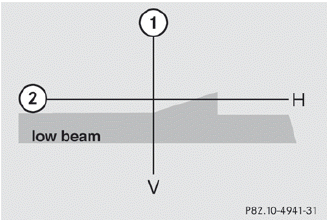
1 V vertical axis
2 H (horizontal) height, measured from the
center
Setting the headlamps correctly is extremely important. Setting the high-beam headlamps also sets the low-beam headlamps. (The term headlamps covers both high and low beam.) To check and adapt the headlamp setting, proceed as follows:
► Park the vehicle on level ground at a
distance of 25 feet (7.6 m) from a wall or
similar.
► Make sure that the vehicle load is in the
normal range.
► Switch on the low-beam headlamps
 .
.
If the light of the headlamps is not distributed
as shown in the illustration above, follow the
instructions below:
► Open the hood.
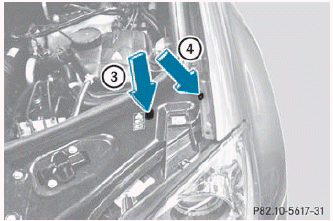
The adjustment screws are located under the cover.
► Insert a suitable tool into the openings in the cover. The directions of arrow 3 and 4 indicate the angle at which the tool needs to be inserted in order to reach the adjustment screws.
► Turn both screws uniformly until the vertical setting of the headlamp corresponds to 1. Turn the screws clockwise to adjust the headlamp upwards and counter-clockwise to adjust it downwards.
Gradation:
• Screw at arrow =: 0.67˚ angle of
inclination
• Screw at arrow?: 0.50˚ angle of
inclination
The left and right headlamps need to be adjusted individually.
 If it is not possible to adjust the
headlamps accurately, have the
adjustment performed at an authorized
Mercedes-Benz Center.
If it is not possible to adjust the
headlamps accurately, have the
adjustment performed at an authorized
Mercedes-Benz Center.
See also:
Notes for 4MATIC vehicles
Vehicles with 4MATIC must not be towed with either the front or the rear axle
raised, as doing so will damage the transmission.
If the vehicle has transmission damage or damage to the front or r ...
Tire pressure of at least 180 kPa
(1.8 bar/26 psi) is not reached
If, after five minutes, a pressure of 180 kPa
(1.8 bar/26 psi) has not been achieved:
•► Press the on/off switch on the tire inflation
compressor to 0.
The tire inflation compressor is swi ...
Useful information
This Operator's Manual describes all
models and all standard and optional
equipment of your vehicle available at the
time of publication of the Operator's
Manual. Country-specific differe ...