
Maximum tire pressure
 WARNING
Never exceed the maximum tire inflation pressure. Follow recommended tire inflation pressures.
Do not underinflate tires. Underinflated tires wear excessively and/or unevenly, adversely affect handling and fuel economy, and are more likely to fail from being overheated.
Do not overinflate tires. Overinflated tires can adversely affect handling and ride comfort, wear unevenly, increase stopping distance, and result in sudden deflation (blowout) because they are more likely to become punctured or damaged by road debris, potholes etc.
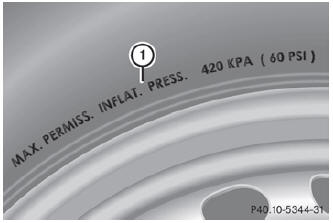
1 Maximum permitted tire pressure (example)
 The actual values for tires are specific to each vehicle and may deviate from
the values in the illustration.
The actual values for tires are specific to each vehicle and may deviate from
the values in the illustration.
When adjusting the tire pressures always observe the recommended tire pressure for your vehicle ().
See also:
Load bearing index
The load bearing index (also load index) is a
code that contains the maximum load bearing
capacity of a tire. ...
Setting and storing the parking position
You can position the front-passenger side
exterior mirror in such a way that you can see
the rear wheel on that side as soon as you
engage reverse gear. You can store this
position.
Make s ...
Setting climate control to automatic
WARNING
If you switch off the cooling function, the
vehicle will not be cooled when weather
conditions are warm. The windows can fog up
more quickly. Window fogging may impair
visibility an ...