
Pedestrian recognition
WARNING
Pedestrian recognition may be impaired or
inoperative if:
• pedestrians are partially or entirely
obscured by objects, e.g. parked vehicles.
• the silhouette of the pedestrian in the Night
View Assist Plus display is incomplete or
interrupted, e.g. by powerful light
reflections.
• pedestrians do not contrast with the
surroundings.
• pedestrians are not standing upright, for
example, if they are sitting, crouching or
lying down.
 Animals are not recognized by pedestrian
recognition.
Animals are not recognized by pedestrian
recognition.
Night View Assist Plus is able to recognize pedestrians by typical characteristics, e.g. a silhouette in the shape of a person.
Pedestrian recognition is then switched on
automatically if:
• Night View Assist Plus is activated.
• you are driving faster than 6 mph
(10 km/h).
• the surroundings are dark, e.g. when
driving outside built-up areas without
street lighting.
If pedestrian recognition is active, symbol 4 appears. If pedestrians are recognized, they are framed 3 and thereby highlighted. If the pedestrian recognition system has brought a pedestrian to your attention, look through the windshield to evaluate the situation. The actual distance to objects and pedestrians cannot be gauged accurately by looking at a screen.
It may be the case that objects are highlighted as well as pedestrians.
Setting the brightness of the multifunction display
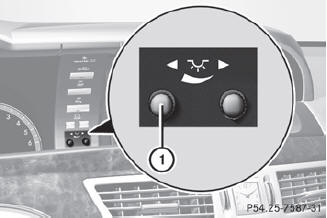
 To make brighter or dimmer: make sure
that Night View Assist Plus is activated.
To make brighter or dimmer: make sure
that Night View Assist Plus is activated.
Turn control 1 counter-clockwise or
clockwise.
See also:
Important safety notes
WARNING
For safety reasons, switch off the windshield
wipers and remove the key from the ignition
lock before changing the wiper blades
(vehicles with KEYLESS-GO: make sure that
the o ...
Vehicle
Display messages
Possible causes/consequences and
Solutions
You have attempted to start the engine with the transmission in
position R or D.
Shift the transmission ...
Switching the ZONE function on/off
•► To switch on: press the
button.
The indicator lamp above the button
lights up.
Dual-zone automatic climate control: the
temperature setting for the driver's side is
not adopt ...