
Maximum tire pressure
WARNING
Never exceed the maximum tire inflation
pressure. Follow recommended tire inflation
pressures.
Do not underinflate tires. Underinflated tires
wear excessively and/or unevenly, adversely
affect handling and fuel economy, and are
more likely to fail from being overheated.
Do not overinflate tires. Overinflated tires can
adversely affect handling and ride comfort,
wear unevenly, increase stopping distance,
and result in sudden deflation (blowout)
because they are more likely to become
punctured or damaged by road debris,
potholes etc.
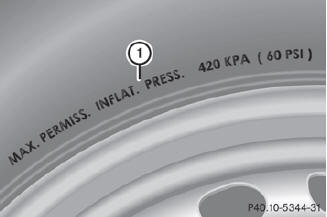
1 Maximum permitted tire pressure (example)
 The actual values for tires are
specific to
each vehicle and may deviate from the
values in the illustration.
The actual values for tires are
specific to
each vehicle and may deviate from the
values in the illustration.
When adjusting the tire pressures always observe the recommended tire pressure for your vehicle.
See also:
Adjusting the four-way lumbar
support
You can adjust the contour of the front seat
backrests individually to provide optimum
support for your back.
1 To raise the backrest contour
2 To soften the backrest contour
3 To lower the ...
Useful information
This Operator's Manual describes all
models and all standard and optional
equipment of your vehicle available at the
time of publication of the Operator's
Manual. Country-specific differe ...
Front air bags
The front air bags increase protection for the
driver's and front-passenger's head and
chest.
Driver's air bag 1 deploys in front of the
steering wheel; front-passenger front air
bag 2 depl ...