
Front air bags
The front air bags increase protection for the driver's and front-passenger's head and chest.
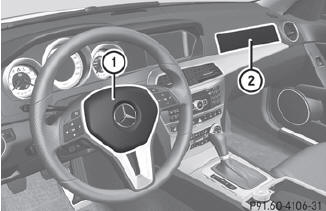
Driver's air bag 1 deploys in front of the steering wheel; front-passenger front air bag 2 deploys in front of and above the glove box.
They are deployed:
• in the event of certain frontal impacts
• if the system determines that air bag deployment can offer additional
protection to that provided by the seat belt
• if the seat belt is fastened
• independently of other air bags in the vehicle
Your vehicle has adaptive, two-stage front air bags. In the event of a collision, the air bag control unit evaluates the vehicle deceleration. In the first deployment stage, the front air bag is filled with enough propellant gas to reduce the risk of injuries.
The front air bag is fully deployed if a second deployment threshold is exceeded within a few milliseconds.
The deployment of the front-passenger front air bag is also influenced by the weight category of the front passenger, which is determined by the Occupant Classification System (OCS).
The lighter the passenger side occupant, the higher the vehicle deceleration rate required (predicted at the start of the impact) for second stage inflation of the front-passenger front air bag. In the second stage, the front air bags are inflated with the maximum amount of propellant gas available.
The front air bags are not deployed in situations where a low impact severity is predicted. You will then be protected by the fastened seat belt.
The front-passenger front air bag will only
deploy if:
• the system, based on the OCS weight
sensor readings, detects that the frontpassenger
seat is occupied.
• the  indicator lamp in the center
console is not lit.
indicator lamp in the center
console is not lit.
• the air bag control unit predicts a high
impact severity.
See also:
Sidewall
The part of the tire between the tread and the
bead. ...
Compass function
You can display the current compass
direction heading in which the front of the
vehicle is facing.
1 Current compass heading
2 geo-coordinates
In the compass view, you can see the current
...
Selecting the ideal shift range
Pull the left-hand steering wheel paddle
shifter and hold it in position.
The automatic transmission shifts to the
gear which allows optimum acceleration
and deceleration. To do this, the auto ...