
Front air bags
The front air bags increase protection for the driver's and front-passenger's head and chest.
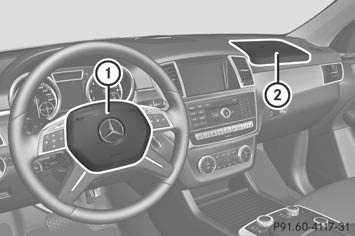
Driver's air bag 1 deploys in front of the steering wheel; front-passenger front air bag 2 deploys in front of and above the glove box.
They are deployed:
- in the event of certain frontal impacts
- if the system determines that air bag deployment can offer additional
protection to that provided by the seat belt
- if the seat belt is fastened
- independently of other air bags in the vehicle
If the vehicle overturns, the front air bags are generally not deployed unless the system detects high vehicle deceleration in a longitudinal direction.
Your vehicle has adaptive, two-stage front air bags. In the event of a collision, the air bag control unit evaluates the vehicle deceleration. In the first deployment stage, the front air bag is filled with enough propellant gas to reduce the risk of injuries.
The front air bag is fully deployed if a second deployment threshold is exceeded within a few milliseconds.
The deployment of the front-passenger front air bag is also influenced by the weight category of the front passenger, which is determined by the Occupant Classification System (OCS).
The lighter the passenger side occupant, the higher the vehicle deceleration rate required (predicted at the start of the impact) for second stage inflation of the front-passenger front air bag. In the second stage, the front air bags are inflated with the maximum amount of propellant gas available.
The front air bags are not deployed in situations where a low impact severity is predicted. You will then be protected by the fastened seat belt.
The front-passenger front air bag will only
deploy if:
- the system, based on the OCS weight
sensor readings, detects that the frontpassenger
seat is occupied.
- the  indicator lamp in the center
console is not lit.
indicator lamp in the center
console is not lit.
- the air bag control unit predicts a high
impact severity.
See also:
Securing cargo
Plastic hooks (Sedan)
On vehicles without a through-loading feature
in the rear bench seat, six plastic hooks are
installed to the trunk floor.
Cargo tie-down rings
Observe the following note ...
Opening and closing
You can continue to operate the
sliding
sunroof after switching off the engine or
removing the SmartKey from the ignition
lock. This function is available for up to five
minutes or until th ...
Charging the batter
WARNING
Never charge a battery still installed in the
vehicle unless a battery charger unit approved
by Mercedes-Benz is being used. Gases may
escape during charging and cause explosio ...